Determinism & forensic traceability.
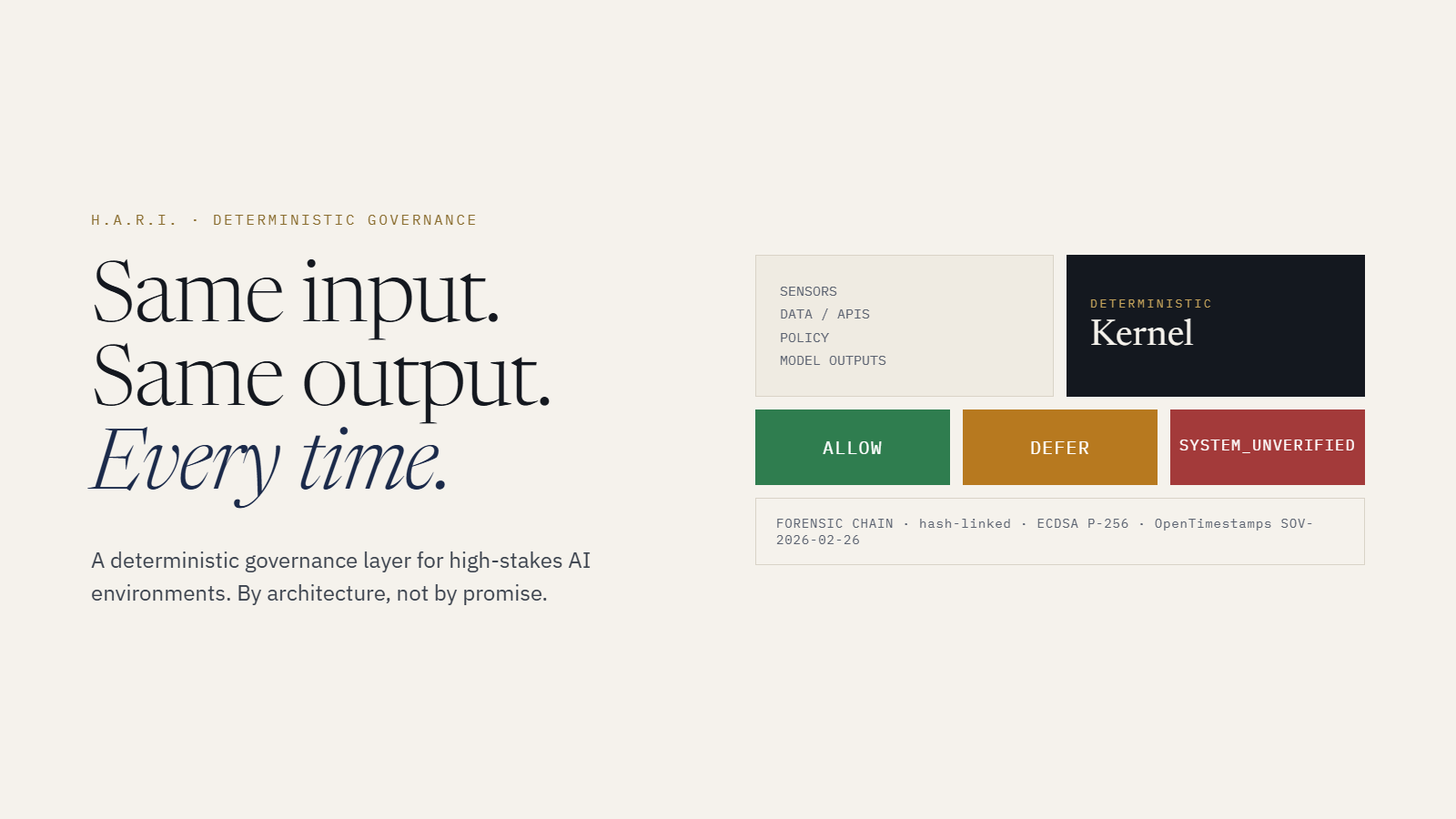
Reproducibility is the institutional property that makes governance possible. The forensic chain is how the property is preserved across years, audits and operational changes.
Why determinism matters
Three institutional consumers, one underlying reason: a non-deterministic decision cannot be reviewed; a deterministic one can.
- Auditors. With determinism, the auditor receives inputs and policy version and re-derives the same output. Audit is a property of the architecture, not a process performed on top of it.
- Regulators. Frameworks for high-stakes AI — the EU AI Act most cited — require explainability, traceability and human oversight. Determinism subsumes traceability; explainability becomes “show the inputs, show the policy, derive the output”.
- Insurers. Pricing depends on reproducible loss estimation. A reproducible layer makes the loss model tractable; a probabilistic one makes it speculative.
The hash-chained audit trail
Each record carries inputs, policy version, output and provenance, signed with ECDSA P-256, with the hash of the previous record in its header.
Tampering is detectable in O(1) per record: modifying any field changes that record’s hash, invalidating the chain from that point. And the chain is append-only — no operation overwrites a prior record, including authorized correction. A correction is a new record referencing the corrected one by hash. The chain accumulates rather than replaces.
ECDSA P-256 signatures
Each record is signed with a P-256 key bound to the issuing layer. P-256 is the primitive used by TLS, major government PKI and the audit-grade signature ecosystem. Deliberate posture: novel cryptography in an audit context introduces review friction. P-256 introduces none.
Replay capability
Any prior decision can be reconstructed. The procedure is mechanical:
The same procedure whether replayed by operations during incident response, by an auditor during review, or by a regulator during inquiry — an hour after the decision or a decade.
OpenTimestamps proof
The chain is bound to wall-clock time via OpenTimestamps; current sealed-core proof SOV-2026-02-26. The proof anchors in the Bitcoin blockchain — not for any cryptocurrency reason, but because it is a public, durable, third-party-independent timeline that cannot be unilaterally rewritten by the platform’s operators.
Probabilistic AI safety vs. deterministic governance
Output filters, moderation classifiers, alignment training are valuable — and statistical. Good for the median case, weak in the tail, not reproducible from a regulator’s desk.
Deterministic governance is a different kind of guarantee: “given these inputs and this policy, this is the output, every time, and here is the chain that proves it.” The two compose — a probabilistic safety layer can be one input the kernel evaluates. But they are not substitutes.
Who holds authority. What is never retained.
Human-Non-Modeled, zero PII retention, recovery paths under human authority, Time Sovereignty.